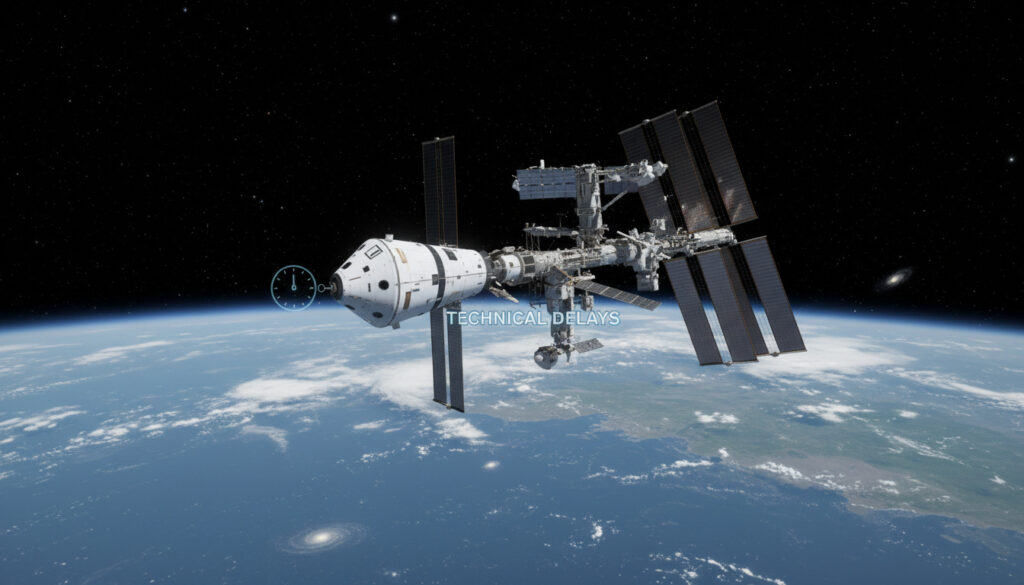
Astronaut Stuck in Space – Boeing Starliner Delays Explained
NASA astronauts Barry “Butch” Wilmore and Sunita Williams launched aboard Boeing’s Starliner spacecraft on June 5, 2024, for what was planned as a brief test flight to the International Space Station. Technical failures involving helium leaks and thruster malfunctions have transformed the mission into an indefinite stay, with the crew now residing on the station for an extended duration that may stretch into 2025.
The spacecraft, designated for Boeing’s first crewed demonstration under NASA’s Commercial Crew Program, successfully docked with the ISS despite critical propulsion issues encountered during approach. Engineers detected multiple helium leaks in the service module and experienced the failure of five aft thrusters, four of which later recovered while one remained inoperative.
While officials emphasize the astronauts are not stranded and maintain emergency return capability, the absence of a confirmed return date has drawn scrutiny to Boeing’s development delays and NASA’s safety protocols. The situation represents a significant setback for the Starliner program, which has faced repeated technical obstacles since its initial uncrewed tests.
Why is the astronaut stuck in space?
The extended mission duration stems from a cascade of technical anomalies affecting Starliner’s propulsion system. During the final approach to the International Space Station on June 6, 2024, five of the spacecraft’s 28 reaction control thrusters failed, delaying docking by approximately one hour. Four thrusters eventually recovered, but one remained offline throughout the remainder of the approach.
Compounding the thruster issues, multiple helium leaks emerged in the service module’s manifolds. NASA was aware of one minor leak prior to launch but discovered four additional leaks once in orbit, traced to flange connections in “doghouse” assemblies housing the Orbital Maneuvering and Attitude Control thrusters. While ground teams tightened bolts to mitigate the issue, leaks persisted at stable, acceptable levels.
Helium serves a critical function pressurizing propellants for both the reaction control thrusters and abort engines. Although the spacecraft maintains over ten times the necessary helium reserves for a safe return, the propulsion anomalies require extensive analysis. Because the service module is jettisoned before re-entry, engineers cannot inspect the hardware post-flight, forcing reliance on telemetry and ground-based testing to understand the root cause.
Sunita Williams & Butch Wilmore
Starliner technical issues
Launched June 2024, extended to 2025
Safe on ISS
- Mission launched with a known minor helium leak deemed acceptable by engineers
- Four additional helium leaks discovered after reaching orbit, traced to flange connections
- Five of 28 reaction control thrusters failed during final approach to the station
- Service module separation before re-entry eliminates post-flight hardware analysis
- Spacecraft maintains over ten times the necessary helium reserves for a safe return
- Original mission duration was approximately one week
| Fact | Details |
|---|---|
| Launch Date | June 5, 2024 |
| Launch Site | Cape Canaveral Space Force Station |
| Crew | Barry “Butch” Wilmore (Commander), Sunita Williams (Pilot) |
| Primary Vehicle | Boeing Starliner (Crew Flight Test) |
| Original Duration | ~7 days |
| Current Status | Extended to 9 months (into 2025) |
| Helium Leaks | 5 total (1 pre-launch, 4 in orbit) |
| Thruster Failures | 5 aft thrusters failed, 4 recovered |
| Current Location | International Space Station |
| Crew Health | Stable, performing duties |
Who are the astronauts currently on extended ISS mission?
Barry “Butch” Wilmore
Wilmore serves as mission commander at 61 years of age. A veteran astronaut with prior International Space Station experience, he has participated in previous long-duration missions and maintains full flight readiness for emergency return procedures. He has contributed to ongoing evaluations of the Starliner spacecraft while continuing regular station operations.
Sunita Williams
Williams, 58, serves as pilot for the mission. Like Wilmore, she brings extensive prior ISS experience to the assignment. Throughout the delay, she has participated in both station maintenance and technical assessments of the docked spacecraft. Grow a Garden Script – Simulate Plant Growth in Python represents the type of scientific computing projects that support long-duration spaceflight research, though specific crew activities focus on spacecraft systems evaluation.
Both astronauts maintain flight readiness for emergency return procedures and have previously completed long-duration missions aboard the International Space Station.
When will the astronauts return to Earth?
Missed Return Windows
The crew’s original schedule envisioned a return approximately one week after launch. That timeline quickly extended to June 26, 2024, before officials indefinitely postponed the departure to allow for additional analysis of the propulsion anomalies. By late June 2024, NASA announced further delays without establishing a new target date.
Extended Mission Duration
By late 2024, reports indicated the mission had extended to a total duration of nine months, implying the astronauts would remain aboard the station into 2025. No return occurred during 2024. Officials emphasize that the spacecraft could undock immediately in the event of an ISS emergency, but standard return requires confidence in the propulsion system’s reliability.
Officials have declined to specify a return date, emphasizing that the spacecraft must meet rigorous safety standards before undocking is approved.
Current status of the astronauts on the ISS
Both astronauts remain in good health, performing regular International Space Station duties alongside the existing crew. Their activities include scientific research, maintenance operations, and continued evaluation of the Starliner spacecraft systems. ABC News reported that the crew has been cleared for emergency return if necessary.
NASA has explicitly rejected characterizations of the crew as “stranded,” noting that the spacecraft maintains functional capability for immediate undocking should a critical situation arise aboard the station. The delay represents a data-driven safety assessment rather than a technical inability to return.
Despite the extended timeline, the spacecraft maintains full capability for emergency undocking and return should a critical situation arise aboard the station.
What is the timeline of the Starliner mission and delays?
- Pre-launch: Engineers identified a persistent helium leak but deemed it acceptable for flight
- June 5, 2024: Starliner launched from Cape Canaveral Space Force Station
- June 6, 2024: Five aft thrusters failed during ISS approach, delaying docking by approximately one hour
- June 7, 2024: Successful docking with the International Space Station achieved
- June 2024: Additional helium leaks discovered; June 26 return target delayed
- Late June 2024: NASA announced indefinite extension for technical analysis
- Late 2024: Mission extended to nine months total, implying 2025 return
Is there really an astronaut stuck in space?
| Established Information | Remaining Uncertainties |
|---|---|
| Five thrusters failed during approach; four recovered | Exact return date for standard operations |
| Multiple helium leaks confirmed in service module | Root cause of thruster malfunctions (helium or software) |
| Astronauts are healthy and performing ISS duties | Timeline for Boeing’s crew certification completion |
| Mission extended from 1 week to 9 months | Whether Starliner will return crew or uncrewed |
| NASA has criticized Boeing’s program delays | Long-term impact on Commercial Crew Program |
What is the broader context of the Starliner delays?
The current situation reflects a history of technical challenges for Boeing’s Commercial Crew Program. Previous setbacks include software glitches during the 2019 uncrewed test flight that prevented the spacecraft from reaching the ISS, corroded valves discovered before a 2022 test attempt, parachute deployment issues, and wiring risks requiring remediation.
NASA’s Commercial Crew Program was designed to provide redundant access to the ISS through both Boeing and SpaceX. While SpaceX’s Crew Dragon has operated regular crew rotations since 2020, Starliner’s delays have left NASA dependent on a single provider for routine access. Fox Business reported that the current delays have intensified scrutiny of Boeing’s development timeline.
The inability to inspect the service module post-jettison complicates engineering analysis, forcing reliance on telemetry and ground simulations. 3.5 Inches to CM – Exact Conversion to 8.89 cm illustrates the precision measurements required in aerospace engineering, where even small discrepancies in component specifications can cascade into system-wide failures.
What have officials said about the mission?
NASA officials have publicly emphasized that safety considerations drive the extended timeline. In public statements, agency representatives have rejected the “stranded” narrative, framing the delay as a methodical approach to understanding propulsion anomalies.
“We are not stranded. The crew can come home anytime we need them to. This is about understanding the data to make sure we have a safe vehicle.”
— NASA spokesperson, via official briefing
Boeing has acknowledged the technical challenges while maintaining that the spacecraft remains stable. The company has worked alongside NASA to develop procedural workarounds, including closing specific valves to isolate the helium leaks and establishing redundant protocols for thruster operations.
What is the latest update on the Starliner crew?
As of the latest reports, NASA astronauts Sunita Williams and Butch Wilmore remain aboard the International Space Station with no confirmed return date. The mission, originally planned for approximately one week, has extended to a nine-month duration. Officials continue analyzing propulsion data to certify the spacecraft for safe return, while the crew maintains emergency return readiness and performs regular station operations.
FAQ
Why did NASA extend the ISS mission?
NASA extended the mission to allow engineers time to analyze helium leaks and thruster failures in Starliner’s propulsion system before certifying the spacecraft for return.
What caused the Starliner thruster issues?
Five aft thrusters failed during approach, likely linked to helium leaks or software issues. Four thrusters recovered, but one remained offline.
How will the astronauts get back home?
The astronauts can return via the Starliner once NASA certifies its propulsion system safe, or potentially through alternative spacecraft if necessary.
What happens next for the ISS crew?
The crew will continue station operations and Starliner evaluations while engineers complete analysis of the propulsion anomalies.
How long has Sunita Williams been in space?
Williams launched on June 5, 2024, and remains on the ISS as part of the extended nine-month mission timeline.
Are the astronauts able to perform science experiments during the delay?
Yes, both astronauts are healthy and actively participating in regular ISS scientific research and maintenance duties alongside the station crew.
More related posts
 What Causes Canker Sore – Triggers, Risks and Prevention
 Leonardo DiCaprio: Personal Life, Facts, and Brad Pitt Quote
 Milo Manheim: Age, Relationships, and Career
 Dylan Sprouse: Bio, Net Worth, Wife, and Life After Disney
 Nikki Bella’s Divorce, Custody, and Life After John Cena
 Totems or Totem Poles: Family Crests, History, and Symbolism
 Redmi Note 11 Pro 5G to Buy in 2024: Is It Worth It?
 PDF to Word Converter Free: The Best No Sign Up Tools