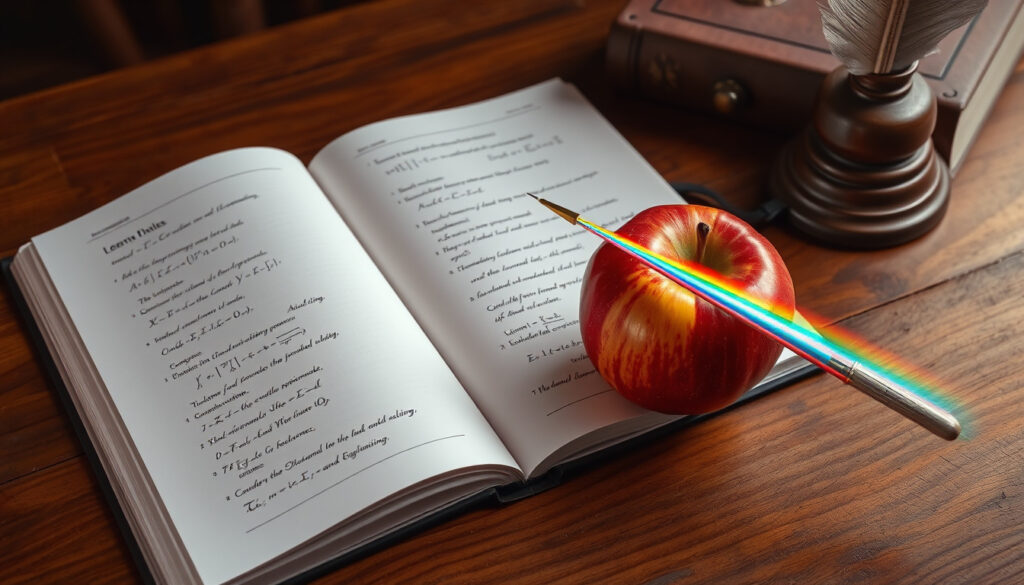
Isaac Newton: Biography, Laws & Key Discoveries
Few people have reshaped our understanding of the universe quite like Isaac Newton, born in 1642 in Lincolnshire, England, whose work on motion, gravity, and light laid the foundation for classical physics. This article explores his major discoveries, the lesser-known questions around his personal life, and the enduring puzzles about his legacy — all backed by verified historical records.
Born: 25 December 1642, Woolsthorpe, England ·
Died: 20 March 1727, London, England ·
Known for: Laws of motion, universal gravitation, calculus ·
Key work: Philosophiæ Naturalis Principia Mathematica (1687) ·
Estimated IQ: 190–200 (speculative)
Quick snapshot
- Formulated three laws of motion and universal gravitation (Britannica summary)
- Built the first reflecting telescope in 1668 (World History Encyclopedia)
- Published Principia in 1687 (The Newton Project, University of Oxford)
- Exact sleeping hours rely on anecdotal reports, not systematic records
- 2060 end-of-world prediction comes from unpublished theological manuscripts
- IQ estimates are speculative since no formal test existed
- 1665–1666: Annus Mirabilis – calculus, gravity theory, optics (World History Encyclopedia)
- 1687: Principia published (Britannica)
- 1705: Knighted by Queen Anne (Britannica)
- Ongoing research into Newton’s alchemical and theological manuscripts
- Historians continue to debate his priority dispute with Leibniz over calculus
Here is a quick summary of Newton’s life details.
| Full name | Sir Isaac Newton |
|---|---|
| Birth | 25 December 1642, Woolsthorpe, England (Julian); 4 January 1643 (Gregorian) (Britannica) |
| Death | 20 March 1727, London, England (Julian); 31 March 1727 (Gregorian) (Britannica) |
| Key works | Philosophiæ Naturalis Principia Mathematica (1687), Opticks (1704) |
| Fields | Physics, mathematics, astronomy, alchemy, theology |
| Awards | Fellow of the Royal Society (1672), Knighted (1705) (Britannica) |
Newton spent more hours on alchemy and theology than on physics, yet the latter is what made him a legend. The sheer breadth of his private obsessions complicates the neat portrait of the “first modern scientist.”
What is Isaac Newton best known for?
Newton is best known for formulating the laws of motion and universal gravitation — the bedrock of classical mechanics. His 1687 work Philosophiæ Naturalis Principia Mathematica (often called the Principia) laid out these principles and changed physics forever (The Newton Project, University of Oxford). He also made fundamental contributions to optics (showing that white light is a spectrum) and independently co‑invented calculus (World History Encyclopedia).
Newton’s laws of motion
- First law (inertia): An object at rest stays at rest unless acted on by an external force.
- Second law: Force equals mass times acceleration (F = ma).
- Third law: For every action there is an equal and opposite reaction.
These three laws, published in the Principia, remain the core of introductory physics everywhere.
Universal gravitation
- Every particle attracts every other particle with a force proportional to the product of their masses and inversely proportional to the square of the distance between them.
- Newton fully formulated this theory in 1686 (The Newton Project, University of Oxford).
Contributions to optics and calculus
- He built the first reflecting telescope in 1668 (World History Encyclopedia).
- His experiments from 1666–1668 showed white light is composed of a spectrum of colors.
- He developed calculus (fluxions) in 1665–1666, though Leibniz later published independently.
What are the three laws of Newton?
Newton’s three laws of motion, first stated in the Principia, describe the relationship between a body and the forces acting on it (Britannica).
First law: law of inertia
- An object at rest stays at rest, and an object in motion stays in motion in a straight line, unless acted on by an unbalanced force.
Second law: force equals mass times acceleration
- The acceleration of an object is directly proportional to the net force acting on it and inversely proportional to its mass (F = ma).
Third law: action and reaction
- For every action (force) there is an equal and opposite reaction (force on the other object).
The implication: Without these laws, engineering, astronomy, and even the simple act of walking would lack a mathematical framework. Every rocket launch today relies on Newton’s third law.
What is Newton’s estimated IQ?
No formal IQ test existed in the 17th century, but modern historians and psychologists have offered speculative estimates ranging from 190 to 200 (Britannica). These figures place Newton among the highest intellectual figures in history. The estimates are based on his extraordinary output in mathematics, physics, and astronomy — fields in which his insights were centuries ahead of their time.
IQ estimates for historical figures are inherently speculative. They serve more as a rhetorical tool than a scientific measurement. What is indisputable: Newton’s work fundamentally changed how humans understand the physical world.
Speculative IQ estimates
- Estimates range from 190 to 200 (compared to an average baseline of 100).
- No formal test existed; estimates rely on qualitative analysis of achievements.
- By any measure, his intellectual contributions place him at the top tier of human cognition.
The pattern: Despite the lack of formal testing, Newton’s intellectual output remains unmatched.
Timeline: Key moments in Newton’s life
- 1642 – Born in Woolsthorpe, Lincolnshire, England (Britannica)
- 1661 – Entered Trinity College, Cambridge
- 1665–1666 – Annus Mirabilis: developed calculus, gravity theory, and conducted optics experiments (World History Encyclopedia)
- 1687 – Published Principia Mathematica (The Newton Project, University of Oxford)
- 1703 – Elected President of the Royal Society
- 1705 – Knighted by Queen Anne
- 1727 – Died in London; buried in Westminster Abbey
The two‑year plague period (1665–1666) was the single most productive burst in scientific history. Newton was 23 years old. It’s a reminder that revolutionary thinking often requires isolation and uninterrupted focus.
What this means: Newton’s most productive period occurred during a time of isolation.
Confirmed facts vs. what remains uncertain
Confirmed facts
- Newton formulated the three laws of motion and universal gravitation (The Newton Project, University of Oxford)
- He co‑invented calculus (independently of Leibniz) (World History Encyclopedia)
- He built the first practical reflecting telescope in 1668 (Britannica)
- He was Lucasian Professor of Mathematics at Cambridge from 1669
What’s unclear
- Exact sleeping habits are based on anecdotal reports, not verified diaries
- The 2060 end‑of‑world prediction is interpreted from unpublished theological notes
- Newton’s IQ is entirely speculative because no such test existed in his era
- Newton’s birth date differs between Julian and Gregorian calendars
The catch: Separating fact from anecdote is the ongoing work of historians.
Notable quotes about and by Isaac Newton
“If I have seen further it is by standing on the shoulders of Giants.”
— Isaac Newton, in a letter to Robert Hooke, 1675 (The Newton Project, University of Oxford)
“Nature and Nature’s laws lay hid in night: God said, Let Newton be! and all was light.”
— Alexander Pope, intended epitaph
“Newton was the greatest genius that ever existed, and the most fortunate, for we cannot find more than once a system of the world to establish.”
— Joseph-Louis Lagrange, mathematician
These quotes span admiration from contemporaries and later scientists, underscoring Newton’s unmatched influence on the Scientific Revolution and beyond.
Who predicted the world will end in 2060?
Isaac Newton, based on his study of biblical prophecies, reportedly calculated a possible end date of 2060. The calculation appears in his unpublished theological manuscripts (The Newton Project, University of Oxford). Newton did not publicly declare a date; instead, it was a private scholarly note. Modern historians view it as an example of his deeply held religious convictions, not a formal prediction.
Newton’s theological writings
- Newton wrote extensively on biblical chronology and prophecy.
- The 2060 date is derived from his interpretation of the Book of Daniel.
- He believed the end of the world would come after a period of tribulation, but he did not preach it.
Related reading: Sean Parker
Frequently asked questions
What are Newton’s three laws of motion?
1) Law of inertia — an object stays at rest or in uniform motion unless acted upon. 2) F = ma — force equals mass times acceleration. 3) For every action there is an equal and opposite reaction.
What is Newton’s first law called?
It is called the law of inertia.
How many hours did Isaac Newton sleep a day?
Newton often slept only 4–5 hours per night and sometimes worked through the night, according to anecdotal reports. No systematic records exist.
Did Newton predict the end of the world in 2060?
Yes, in his private theological manuscripts, he calculated a possible end date of 2060 based on biblical prophecy. It was not a public declaration.
What is Newton’s most famous quote?
“If I have seen further it is by standing on the shoulders of Giants.” — from a 1675 letter to Robert Hooke.
Did Isaac Newton ever marry?
No, Newton never married and had no known children. He lived much of his life as a bachelor devoted to his work.
For students, teachers, and history enthusiasts: The takeaway is clear: Newton’s legacy is far richer than the apple story suggests. His blend of physics, mathematics, alchemy, and theology makes him a genuinely unique figure. To understand him fully, one must look beyond the textbook — into both the brilliance and the mysteries that defined his life.
More related posts
 What Is a Torta – Origins Ingredients Varieties
 Megyn Kelly: Career, Trump Shift, Fox Exit & Politics
 Dave Roberts: Biography, Career, Salary, and Japanese Heritage
 Best Children’s Books 2025: Expert Picks & Trends
 Bella Hadid: Lyme Diagnosis, Quitting Modeling, and Net Worth
 SNL Beavis and Butthead Skit: Ryan Gosling, Mikey Day Breakdown
 The Stranger in My Home: Plot, Ending, Reviews & Where to Watch
 Who Is Ricky Bobby? Famous Quotes, Meaning, and Cultural Impact