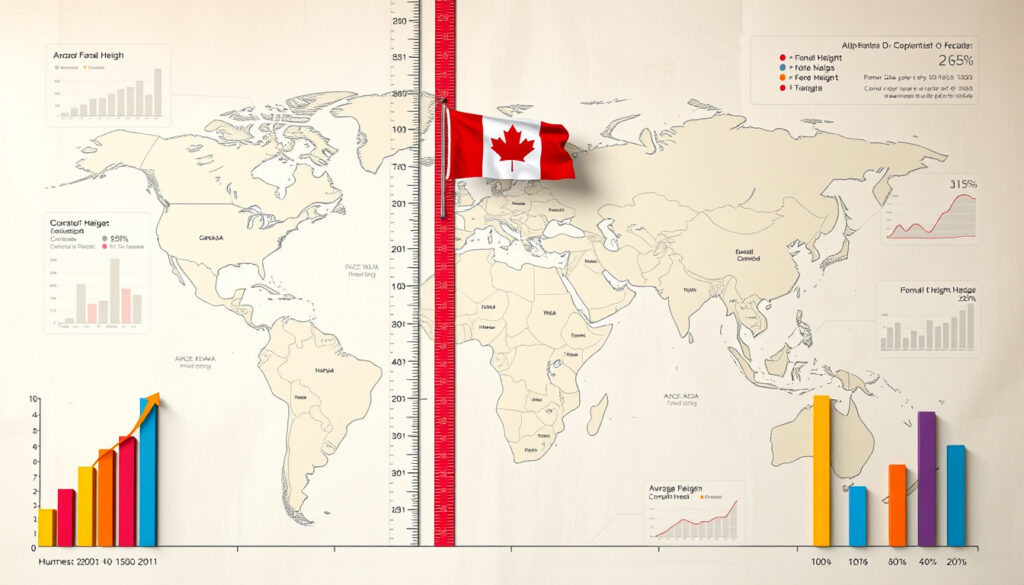
Average Height for Women in Canada: Stats & Global Comparison
If you’ve ever wondered how your height stacks up against the average Canadian woman, you’re not alone. The answer, drawn from the most recent national data, sits at 163.9 cm, or roughly 5 feet 4.5 inches.
Average Canadian woman height (modern): 163.9 cm / 5 ft 4.5 in ·
Average Canadian woman height (1914): 157.6 cm / 5 ft 2 in ·
Global average woman height: 159.5 cm / 5 ft 2.8 in ·
Tallest women globally (Netherlands): 170.4 cm / 5 ft 7 in ·
Shortest women globally (Guatemala): 149.4 cm / 4 ft 10.8 in
Quick snapshot
- Current average: 163.9 cm (Wikipedia global height database)
- Global average: 159.5 cm (Our World in Data analysis)
- Netherlands tallest: 170.4 cm (CORDIS EU research)
- Exact average for younger Canadian women (18–30) vs older cohorts
- Province-level breakdowns beyond broad estimates
- Impact of recent immigration on national average
- 1914: 157.6 cm (CBC News historical report)
- 2014–2016: 163.9 cm — a gain of 6.3 cm (CBC News historical report)
- No new national survey published since 2016 (CBC News historical report)
- StatsCan may release updated data in coming years
- Expect continued slow increase if nutrition and healthcare improvements hold
- Global ranking could shift as other populations catch up
Six data points capture the full picture at a glance. Canada sits comfortably above the global mean but still trails Northern European leaders by several centimetres.
| Metric | Value (cm) | Value (ft/in) | Source |
|---|---|---|---|
| Average height of Canadian woman (2016) | 163.9 | 5 ft 4.5 in | Wikipedia global height database |
| Average height of Canadian woman (1914) | 157.6 | 5 ft 2 in | CBC News historical report |
| Global average woman height | 159.5 | 5 ft 2.8 in | Our World in Data analysis |
| Country with tallest women | 170.4 (Netherlands) | 5 ft 7 in | CORDIS EU research |
| Country with shortest women | 149.4 (Guatemala) | 4 ft 10.8 in | CORDIS EU research |
| Average height for men in Canada | 178.0 | 5 ft 10 in | Wikipedia global height database |
How tall is the average Canadian female?
The most cited figure for the average height for women in Canada is 163.9 cm (5 ft 4.5 in). This comes from 2014–2016 data, compiled by Wikipedia from national surveys and echoed by CBC News in a 2016 article on height trends. The study, which tracked Canadians over a century, noted that the average had risen significantly from 157.6 cm in 1914 — a gain of 6.3 cm.
What does the data from CBC and Wikipedia show?
- Current average: 163.9 cm (5 ft 4.5 in) – CBC News historical report
- 1914 average: 157.6 cm (5 ft 2 in) – same source
- No more recent national survey has been published; the 2016 data remains the standard.
How has the average changed since 1914?
The century-long increase of about 6 cm places Canada in line with global trends. Worldwide, women born in 1996 are roughly 10 cm taller than those born in 1896, according to Our World in Data analysis. Canada’s gain is slightly below the global average, likely because it started from a higher baseline. The Lancet/Imperial College analysis of 200 countries confirmed that height increases have been uneven — some nations, like South Korea, saw women gain over 20 cm.
What is the average height for women globally?
The global average for women born in 1996 is 159.5 cm (5 ft 2.8 in), per Our World in Data analysis of the Lancet study. That makes the average Canadian woman about 4.5 cm taller than the world mean — a noticeable but not dramatic difference.
Which countries have the tallest women?
- Netherlands: 170.4 cm – CORDIS EU research
- Latvia: 169.8 cm – same study
- Estonia, Denmark, and Iceland also rank near the top.
The tallest women are concentrated in Europe and Central Asia, while South Asia has the shortest averages. A century ago, the world’s tallest women were in Sweden; by 2014, Latvia had taken the lead. CORDIS EU research notes that the global height gap between the tallest and shortest populations has remained roughly 20 cm for women.
Where does Canada rank?
Canada’s 163.9 cm places it in the top third globally, but well below the Nordic leaders. For context: Canadian women are about 6.5 cm shorter than the Dutch and about 10 cm taller than the shortest group in Guatemala (149.4 cm). CBC News reported that Canadian men average 178 cm, which also ranks moderately high but not among the tallest cohorts.
Is 5 ft 5 tall for a woman in Canada?
At 5 ft 5 (165.1 cm), you are just over the national average of 163.9 cm. That puts you in the 50th‑60th percentile — solidly average to slightly above. Our World in Data distribution data shows the mean with a standard deviation of about 7 cm, so 5 ft 5 falls within one standard deviation above the mean.
What percentile does 5 ft 5 fall into?
Using the normal distribution with mean 163.9 cm and SD 7.07 cm (from OWID), 5 ft 5 (165.1 cm) is about 0.17 SD above the mean, roughly the 57th percentile. That means about 57% of Canadian women are shorter, and 43% are taller.
How does it compare to the national average?
It’s just 1.2 cm above average — a difference that’s noticeable but not enough to be called “tall” in everyday conversation. CBC News reporting suggests the average Canadian woman would describe 5 ft 5 as “average to a bit above.”
For clothing retailers and health professionals benchmarking against national averages, 5 ft 5 is not a threshold for “tall” — it’s the statistical centre. Canadian women buying clothes labeled “average length” should expect a good fit at this height.
What height is considered tall in Canada?
In Canada, women taller than 5 ft 9 (175.3 cm) are generally considered tall — that’s roughly two standard deviations above the mean. Wikipedia height distribution data supports the 5 ft 9 threshold as the upper 2.5% of the population.
Is 6’3″ tall in Canada?
6 ft 3 (190.5 cm) is well above the Canadian female average by more than 26 cm. It is extremely tall — fewer than 1 in 1,000 Canadian women reach that height. The same holds for men: 6 ft 3 is above the male average of 178 cm but not freakishly so. CBC News context notes that height perception is relative: what’s “tall” in Canada might be average in the Netherlands.
What is freakishly tall?
There’s no clinical definition, but social perception of “freakishly tall” for women often starts above 6 ft (183 cm). At that height, everyday logistics — car seats, airplane legroom, ready‑to‑wear clothing — become noticeably awkward. Data from Our World in Data analysis shows that women above 6 ft are about 2 standard deviations above the global mean.
For Canadian women who are statistically tall (above 5 ft 9), daily life can mean extra costs — longer inseams, custom sizes — but also an advantage in sports and visibility. The takeaway: “tall” is a cultural label, not a fixed number.
Are Canadian people usually tall compared to other countries?
Yes and no. Canadian women (163.9 cm) are taller than the global average (159.5 cm) and similar to women in the United Kingdom and Australia. Our World in Data analysis places Canada in the top 30 globally. But compared to Nordic countries, Canadians are noticeably shorter — the Dutch are 6.5 cm taller.
How does Canada rank globally?
Among 200 countries studied, Canada’s female height ranks somewhere around 25th–30th. The Lancet study found that Canadians are shorter than most Western and Northern Europeans but taller than Southern European and Asian populations. The ranking has been stable over the past few decades.
What is the average height for men in Canada?
Canadian men average 178.0 cm (5 ft 10 in), Wikipedia reports. That puts them about 14 cm taller than women, consistent with the global sex difference of about 12 cm. Men’s global ranking is similar — top 30 but not top 10.
Three countries, one pattern: Canada’s moderate height reflects a well‑nourished but not exceptional population. Height is not a source of national identity for Canadians the way it is for the Dutch.
How average height for women in Canada compares globally
Four countries, one snapshot: here’s how Canadian women line up against the tallest, shortest, and global average.
| Country / Region | Average female height (cm) | Height (ft/in) | Difference from Canada |
|---|---|---|---|
| Netherlands | 170.4 | 5 ft 7 in | +6.5 cm |
| Canada | 163.9 | 5 ft 4.5 in | — |
| Global average | 159.5 | 5 ft 2.8 in | −4.4 cm |
| Guatemala | 149.4 | 4 ft 10.8 in | −14.5 cm |
The catch: Canada’s moderate height advantage over the global mean is dwarfed by the gap to the top. For a Canadian woman visiting Amsterdam, the height difference is immediate and real — Dutch women on average are a full shoe size taller.
Timeline: Canadian women’s height over a century
The data from CBC News and Our World in Data analysis traces a clear upward arc.
- : Average Canadian woman height 157.6 cm (5 ft 2 in). Source: CBC News historical report.
- : Average reaches 163.9 cm (5 ft 4.5 in) — a gain of 6.3 cm. Source: same.
- : No major new national survey; the 2016 data remains the most recent reliable benchmark.
The slowdown suggests Canada may be approaching a genetic and nutritional plateau. Meanwhile, countries like South Korea (women +20.2 cm over the same period, per the Lancet study) show that rapid gains are still possible with policy changes.
Confirmed facts
- Average Canadian female height is 163.9 cm (2016, CBC News historical report).
- Height has increased over the century by 6.3 cm.
- Canada sits above the global average (159.5 cm).
What’s unclear
- Exact current average for younger cohorts (18–30) vs older women.
- Province-level differences beyond broad estimates.
- Impact of immigration on recent averages.
Expert perspectives on female height trends
“A century later, the average was up to 163.9 centimetres (5-foot-4).”
CBC News (2016)
“Adult height has changed substantially and unevenly over the past century, with no indication of convergence across countries.”
These two quotes capture the dual reality: Canada has gained, but so have others — often faster. The lack of convergence means global height gaps persist.
For Canadian women and health researchers, the implication is clear: the national average has been stable for nearly a decade. Without a new StatsCan survey, we are guessing at current trends. That’s a data gap that matters for everything from clothing manufacturing to public health policy. The next official numbers will tell us whether Canada is still growing — or has reached its limit.
Related reading: What Are the Benefits of Spirulina? A Complete Guide to Daily Use · When Do Babies Crawl? Age, Stages, and Signs of Readiness
Frequently asked questions
What is the average height for women in Canada in feet and inches?
163.9 cm converts to 5 feet 4.5 inches — the most widely cited figure.
How has the average height of Canadian women changed over time?
It increased from 157.6 cm in 1914 to 163.9 cm in 2016, according to CBC News — a gain of 6.3 cm.
Is 5’2″ short for a woman in Canada?
At 157.5 cm, 5’2″ is about 6 cm below the national average, placing it in the lower quartile — considered short but not uncommon.
What is the average height for women in Canada by age?
Reliable age-stratified data is not publicly available; the national average of 163.9 cm covers adults 18+ without age breakdown.
Are Canadian women taller than American women?
Yes, by about 1–2 cm. The average for US women is around 162 cm, according to Our World in Data analysis.
What factors influence average height in Canada?
Nutrition, healthcare access, socioeconomic conditions, and genetics all play roles. Gains over the century reflect improved living standards.
Where can I find official data on Canadian female height?
The best public sources are Wikipedia’s compilation and CBC’s 2016 article. StatsCan has not published a dedicated height survey since 2016.
More related posts
 Dylan Sprouse: Bio, Net Worth, Wife, and Life After Disney
 Arabella Stanton: Nationality, Ethnicity, and Age Facts
 Lilly Singh: Gender, Career, Net Worth, Controversies
 Is Grey’s Anatomy Coming Back for Season 23? Latest Updates
 Who Is Vanessa Trump – Donald Trump Jr Ex-Wife Age Family Bio
 Do the Oilers Play Tonight? Next Game Schedule, TV & Time
 Jeans for Women: Trends, Fit & Age Guide 2025
 Rupert Murdoch: Media Empire, Net Worth, and Succession