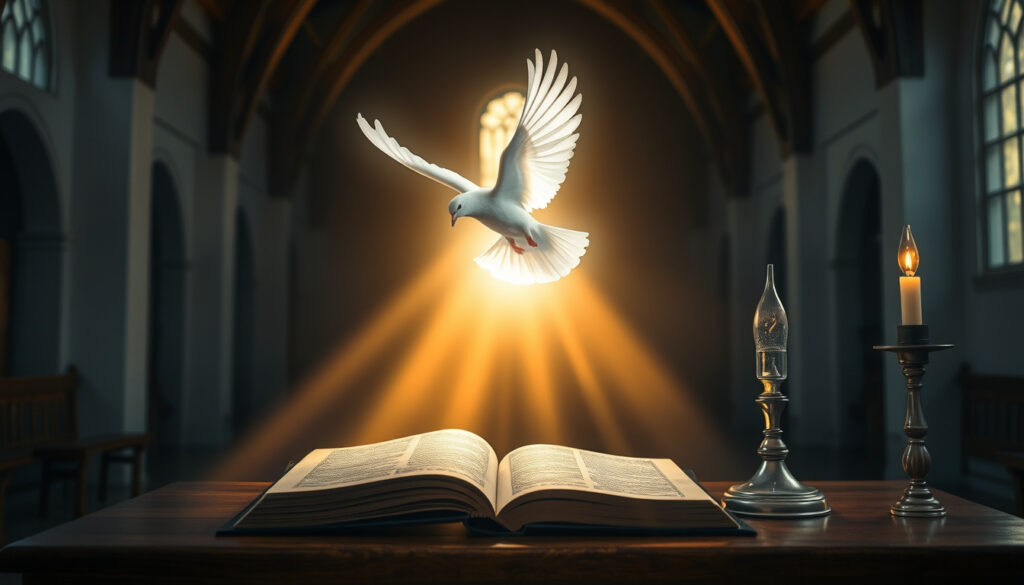
Holy Spirit Guide: What Is the Paraclete and His Role
If you’ve spent any time in church or reading the Bible, you’ve likely heard the phrase “Holy Spirit” dozens of times — but what, or who, is it really? For many Christians, the Holy Spirit remains the most mysterious member of the Trinity, often pictured as a vague spiritual vapor rather than a personal guide. This guide unpacks the biblical identity of the Holy Spirit as the Paraclete — a Helper, Teacher, and Advocate — and walks through what Scripture actually says about His work in the life of believers.
Times mentioned in the New Testament: 264 ·
Fruits of the Spirit (Galatians 5:22–23): 9 ·
Gifts of the Spirit (1 Corinthians 12:8–10): 9 ·
Books in the New Testament that reference the Holy Spirit: all 27
Quick snapshot
- The Holy Spirit is a divine person, not an impersonal force (Ministry Magazine)
- The Spirit is called the Paraclete — Helper, Advocate, and Teacher — in John’s Gospel (JesusWalk Bible Study)
- The Holy Spirit inspired all Scripture (2 Peter 1:21) (Ministry Magazine)
- Whether the seven powers (Isaiah 11) are the same as the nine charismatic gifts from 1 Corinthians 12
- Whether Spirit baptism is a separate event from conversion or occurs at the same moment
- The exact timeline for cessation of certain miraculous gifts
- John 14:16 — Jesus first promises “another Paraclete”
- John 14:25–26 — The Spirit will teach and remind
- Acts 2:1–4 — The Spirit is poured out at Pentecost
- Growing scholarly interest in distinguishing the Spirit’s role as Paraclete from later theological traditions like the seven gifts
- Continued pastoral focus on helping believers recognize the Spirit’s indwelling without dependence on a single external sign
The Spirit is the most active person of the Trinity in the life of a believer, yet also the least understood.
| Category | Detail |
|---|---|
| Divine status | Co-equal with Father and Son |
| Key title | Paraclete (Helper) |
| NT mentions | 264 |
| Role in salvation | Regeneration, indwelling, sealing |
| Symbols | Dove, wind, fire, oil |
What exactly is the Holy Spirit?
Definition of the Holy Spirit in Christian theology
- The Holy Spirit is the third person of the Trinity — fully God, co-equal with the Father and the Son (Ministry Magazine)
- Scripture uses personal pronouns (“He,” “Him”) for the Spirit, not “it”
- The Spirit is described as teaching, reminding, guiding, speaking, hearing, glorifying, testifying, and convicting — all personal actions (Ministry Magazine)
The Holy Spirit as the third person of the Trinity
Within orthodox Christian theology, the Holy Spirit is not a force or an energy field but a distinct person who proceeds from the Father and the Son. The Nicene Creed (A.D. 325) affirmed that the Spirit is “worshipped and glorified” together with the Father and the Son. The C.S. Lewis Institute notes that the Spirit can be lied to (Acts 5:3), grieved (Ephesians 4:30), and resisted (Acts 7:51) — actions that only make sense if the Spirit is a person.
Common misconceptions about the Holy Spirit
Many Christians and non-Christians alike picture the Holy Spirit as a vague glow, an impersonal “force” like in Star Wars, or simply the “nice” part of God. But John 14:16–17 explicitly calls the Spirit “another Paraclete” — Greek parakletos, meaning helper, adviser, strengthener, encourager, ally, and advocate (C.S. Lewis Institute). The Spirit is not an impersonal power but an Agent of God sent to continue the work Jesus began.
A believer who treats the Holy Spirit as an impersonal force misses the central biblical point: the Spirit is a person who teaches, guides, and forms relationships — not a resource to be “used.”
The implication: the Holy Spirit is not a doctrine to master but a person to relate to.
What are the 7 powers of the Holy Spirit?
Origins of the seven powers in Isaiah 11:2
- The “seven powers” tradition traces to Isaiah 11:2, which describes the Spirit resting on the Messiah: the Spirit of wisdom and understanding, counsel and might, knowledge and fear of the Lord (C.S. Lewis Institute)
- The Latin Vulgate and the Catholic Catechism (CCC 1831) later expanded this into the list of “seven gifts of the Holy Spirit”
- These are not the same as the nine charismatic gifts listed in 1 Corinthians 12:8–10
The seven spirits mentioned in Revelation
Revelation 1:4 and 4:5 refer to “the seven spirits of God” before God’s throne. Some interpreters connect this to the Isaiah 11 passage, while others see it as a symbolic reference to the Holy Spirit’s fullness. The C.S. Lewis Institute views the imagery as emphasizing the Spirit’s perfect, sevenfold operation — not seven separate beings.
Difference between the seven powers and the nine gifts of the Spirit
The seven powers (or gifts) from Isaiah 11 describe the Spirit’s character and are given to the Messiah — and by extension to all believers — as enduring qualities. The nine gifts from 1 Corinthians 12:8–10 (wisdom, knowledge, faith, healing, miracles, prophecy, discernment, tongues, interpretation) are manifestations distributed sovereignly to individuals for the common good (Sam Storms). Confusing the two lists is one of the most common misunderstandings in modern charismatic circles.
Some popular “seven powers of the Holy Spirit” teachings online conflate Isaiah’s seven attributes with the charismatic gifts. The biblical text keeps them separate — one is the character of the Spirit, the other is the distribution of spiritual abilities.
What does John 14:26 say about the Holy Spirit?
The promise of the Paraclete
John 14:26 records Jesus telling his disciples: “But the Helper, the Holy Spirit, whom the Father will send in my name, he will teach you all things and bring to your remembrance all that I have said to you.” The Greek word parakletos here is translated “Helper” in the ESV, “Advocate” in the NIV, and “Comforter” in the KJV. JesusWalk Bible Study explains that this is the same term used in 1 John 2:1 for Jesus as our advocate with the Father — the Spirit is “another Paraclete” of the same kind.
Teaching and reminding role of the Holy Spirit
- The Spirit will teach believers all things — not merely knowledge, but deep, transforming understanding (JesusWalk Bible Study)
- The Spirit will remind believers of everything Jesus said — a promise particularly meaningful for the apostles who wrote the Gospels
- This teaching role continues today: believers depend on the Spirit for illumination of Scripture and guidance in daily decisions (C.S. Lewis Institute)
Connection to the missing purposes sermon
Some pastors and theologians observe that Jesus’s Farewell Discourse (John 14–17) functions as a “missing sermon” — teachings the disciples could not bear before the crucifixion, which the Spirit would later bring to their remembrance. Ministry Magazine argues that the Spirit continues the work Jesus initiated, making the Paraclete the ongoing presence of Christ with his people.
For Christians who have ever felt abandoned in their faith, John 14:26 is the direct answer: the Spirit is still teaching, still reminding, and still guiding — not as a distant memory of Jesus but as a present person.
What happens when the Holy Spirit is in you?
Transformation of character (fruit of the Spirit)
- Galatians 5:22–23 lists nine fruits of the Spirit: love, joy, peace, patience, kindness, goodness, faithfulness, gentleness, and self-control
- These characteristics are not produced by human effort but are the natural result of the Spirit’s indwelling (C.S. Lewis Institute)
- The fruit of the Spirit contrasts with the “works of the flesh” listed in Galatians 5:19–21
Empowerment for witnessing and service
Jesus told the disciples in Acts 1:8: “But you will receive power when the Holy Spirit has come upon you, and you will be my witnesses in Jerusalem and in all Judea and Samaria, and to the end of the earth.” The same Spirit who empowers preaching also gives specific spiritual gifts for building up the church. Sam Storms notes that 1 Corinthians 12:7 declares “each one” receives a manifestation of the Spirit for the common good — not just pastors or “super-saints.”
Assurance of salvation and adoption as children of God
Romans 8:16 is one of the most comforting verses in the New Testament: “The Spirit himself bears witness with our spirit that we are children of God.” This internal testimony is not an emotional feeling but a settled conviction produced by the Spirit. The same chapter (Romans 8:15) says believers cry out “Abba! Father!” by the Spirit — the intimacy of a child addressing a parent.
Many Christians chase external signs to prove the Spirit is in them, but Romans 8:16 says the primary evidence is internal: a deep, Spirit-produced assurance that you belong to God.
What this means: the Spirit’s indwelling is not about spectacular experiences but about profound transformation and settled identity.
How do I know I have the Holy Spirit?
Internal witness and conviction
- Romans 8:16: “The Spirit himself testifies with our spirit that we are God’s children” (C.S. Lewis Institute)
- 1 John 3:24: “And by this we know that he abides in us, by the Spirit whom he has given us”
- The Spirit also convicts of sin, righteousness, and judgment (John 16:8)
Evidence of spiritual gifts and fruit
The presence of the fruit of the Spirit (Galatians 5:22–23) and the operation of spiritual gifts (1 Corinthians 12) are practical indicators. But Sam Storms warns against assuming that every believer will display the same external signs. Gifts are distributed sovereignly by the Spirit “as he wills” (1 Corinthians 12:11).
Contrasting with external signs like speaking in tongues
A common misconception — particularly in some Pentecostal circles — is that speaking in tongues is the only evidence of being filled with the Spirit. But 1 Corinthians 12:30 asks rhetorically, “Do all speak in tongues?” — the implied answer is no. The C.S. Lewis Institute emphasizes that the Spirit’s presence is best shown by love, joy, peace, and a life that increasingly reflects Christ — not by a single manifestation.
Focusing exclusively on tongues as the sign of the Spirit excludes many sincere believers and creates an unbiblical hierarchy of spirituality. The biblical witness is broader: the Spirit is known by His fruit, His gifts, and His internal witness — not by any one phenomenon.
The pattern: the New Testament consistently points to a Spirit-filled life marked by love and character, not by a checklist of experiences.
For a deeper look at how believers can recognize the Spirit’s work, explore the signs and powers of the Holy Spirit in daily life.
Frequently asked questions
What is the blasphemy against the Holy Spirit?
Jesus mentions this in Matthew 12:31–32 as the one unforgivable sin. Most theologians interpret it as the persistent, willful rejection of the Spirit’s testimony about Christ — attributing the Spirit’s work to Satan. It is not a single slip of the tongue but a hardened, final refusal of God’s witness.
Can a Christian lose the Holy Spirit?
Ephesians 1:13–14 describes the Spirit as a “seal” and a “guarantee” of inheritance — language that suggests permanence for genuine believers. However, a believer can grieve the Spirit (Ephesians 4:30) and quench the Spirit’s work (1 Thessalonians 5:19) through persistent sin.
How does the Holy Spirit guide believers today?
Through Scripture (2 Peter 1:21), through internal conviction (Romans 8:14), through wise counsel from other believers (Acts 15:28), and through circumstances. The Spirit never contradicts the written Word (C.S. Lewis Institute).
Is speaking in tongues the only evidence of the Holy Spirit?
No. 1 Corinthians 12:30 explicitly says not all speak in tongues. The fruit of the Spirit (Galatians 5:22–23) and the internal witness of adoption (Romans 8:16) are more universal indicators (Sam Storms).
What is the role of the Holy Spirit in prayer?
Romans 8:26 says the Spirit helps believers in their weakness, interceding with “groanings too deep for words.” The Spirit also enables believers to pray according to God’s will and aligns their hearts with the Father.
Are the seven powers of the Holy Spirit the same as the gifts?
No. The seven powers (or gifts) from Isaiah 11:2 describe the Spirit’s character attributes — wisdom, understanding, counsel, might, knowledge, and fear of the Lord. The nine gifts in 1 Corinthians 12:8–10 are manifestations distributed sovereignly to believers for ministry (C.S. Lewis Institute).
How does the Holy Spirit differ between Catholic and Protestant theology?
Both affirm the Spirit as the third person of the Trinity. A key difference: Catholic theology has a developed tradition of seven gifts of the Holy Spirit (from Isaiah 11) and emphasizes the Spirit’s role in the sacraments, especially confirmation. Protestant theology tends to emphasize the Spirit’s role in individual regeneration, Scripture illumination, and the distribution of charismatic gifts.
What Scripture says — four key voices
“But the Helper, the Holy Spirit, whom the Father will send in my name, he will teach you all things and bring to your remembrance all that I have said to you.”
— Jesus Christ (John 14:26, ESV), promising the Paraclete to his disciples
“To each is given the manifestation of the Spirit for the common good. For to one is given through the Spirit the utterance of wisdom, and to another the utterance of knowledge according to the same Spirit.”
— Apostle Paul (1 Corinthians 12:7–8, ESV), describing the diversity of spiritual gifts
“But the fruit of the Spirit is love, joy, peace, patience, kindness, goodness, faithfulness, gentleness, self-control; against such things there is no law.”
— Apostle Paul (Galatians 5:22–23, ESV), defining the character produced by the Spirit’s indwelling
“And it shall come to pass in the last days, says God, that I will pour out my Spirit on all flesh; your sons and your daughters shall prophesy, your young men shall see visions, and your old men shall dream dreams.”
— Peter quoting the prophet Joel (Acts 2:17, ESV), at the outpouring of the Spirit on Pentecost
Related reading
For further exploration of the Holy Spirit and related topics:
- Totems or Totem Poles: Family Crests, History, and Symbolism — A look at how different cultures understand spiritual symbolism, offering a comparative lens for understanding religious imagery
- Conjoined Twin: Causes, Types, and Ethical Dilemmas — An exploration of ethical questions that parallel the deep theological discussions surrounding personhood and the work of the Spirit
The Holy Spirit is not a vague power or a theological abstraction but a person — the Paraclete sent by Jesus to teach, guide, and transform believers from the inside out. For Christians seeking to understand their faith, the practical implication is clear: the Spirit’s primary evidence is not a spectacular sign but a transformed character, an assured identity, and the ongoing experience of being taught and reminded by God himself.
More related posts
 Steve Buscemi: Biography, Career, and Personal Life
 Lilly Singh: Gender, Career, Net Worth, Controversies
 Real Estate License Ontario: Costs, Exam & Timeline
 Dacre Montgomery: Why He Quit Hollywood, Wife, Height, and More
 The Old Man and the Sea: Summary, Themes & Analysis
 How Did Elvis Presley Die? Cause, Myths & Medical Facts
 Randy Quaid: Trump Supporter, Brother Feud, Why He Stopped Acting
 Prince Andrew: Current Status, Legal Cases, and Royal Protocol